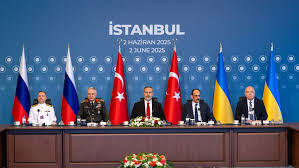
Third Round of Peace Talks Scheduled Today, but Deep Divides and U.S. Pressure Shape the Mood
Ukraine and Russia may resume peace talks in Istanbul today for the first time in over seven weeks. The stakes are high—so is the skepticism. Despite intensifying U.S. pressure, particularly from President Donald Trump’s recent 50-day peace ultimatum to Russia, analysts warn that a breakthrough is unlikely as the warring parties remain miles apart in both rhetoric and strategic goals.
What’s at Stake in Istanbul
From War Fatigue to Political Deadlock
Ukrainian and Russian delegations are expected to meet for a third round of peace negotiations, following inconclusive rounds in May and June. Unlike the prior meetings, today’s discussions come amid escalated hostilities and a looming deadline from Washington. U.S. President Trump’s ultimatum—strikingly blunt even by his standards—has injected urgency into the process: either reach a deal within 50 days or face what he called “crippling sanctions.”
Despite this pressure, Russian officials have already warned against any “miraculous breakthroughs.” Kremlin spokesperson Dmitry Peskov said the meeting—if it occurs—should not raise hopes for a dramatic shift.
Russia’s Red Lines: Territorial Concessions or Nothing
Moscow’s Demands Put Peace Out of Reach
At the center of the impasse lies a core non-starter: Russia demands Ukraine officially cede control of the four regions Moscow claimed to annex in September 2022—Donetsk, Luhansk, Kherson, and Zaporizhzhia. Ukraine has categorically rejected this, labeling any concession of territory “unacceptable.” Kyiv maintains that all negotiations over land, including Crimea, must wait until after a full ceasefire.
This territorial standoff isn’t new, but it’s hardening. Russia views these areas as non-negotiable parts of its sovereign territory. Ukraine sees any compromise as rewarding aggression.
Who’s Leading the Talks?
Familiar Faces, But No Big Names
Ukraine is sending Rustem Umerov, its current Security Council secretary and former defense minister, to lead the delegation. Russia, meanwhile, will once again dispatch political scientist Vladimir Medinsky. He previously headed Moscow’s delegation in the May and June rounds.
Ukrainian officials have dismissed Medinsky as a “puppet” with little real influence. Many observers believe that meaningful movement would require involvement from senior Kremlin officials or President Vladimir Putin himself. But the Kremlin has stated plainly that “a lot of work” remains before a summit between Putin and Ukrainian President Volodymyr Zelensky can even be considered.
Past Talks: Prisoner Swaps but No Peace
What Was Achieved in May and June?
Despite the pessimism surrounding today’s session, the two earlier meetings did produce limited agreements. Both sides agreed to large-scale prisoner exchanges, and negotiators exchanged initial drafts of potential peace frameworks. However, those drafts were, as the Kremlin put it, “diametrically opposed.”
Since then, momentum has stalled. Russia has intensified its attacks across the eastern and southern front lines, while Ukraine has increased international appeals for weapons and financial aid.
The Trump Factor: “50 Days or Else”
America’s Hardline Deadline Looms Large
Trump’s recent threat has further complicated the geopolitical terrain. Speaking last week, the former and potentially future U.S. president gave Moscow 50 days to strike a deal or face “bruising sanctions” far beyond current levels. While many international observers questioned the legality or scope of Trump’s ultimatum, its political impact is undeniable.
The U.S. remains Ukraine’s largest military backer, and Trump’s return to the center of the diplomatic narrative suggests a new phase—one where Washington may take a more coercive approach.
Turkey’s Role: Diplomatic Mediator or Spectator?
Erdogan Pushes Dialogue, But Influence Limited
Turkey, a NATO member with ties to both Kyiv and Moscow, is hosting the talks once again. President Recep Tayyip Erdoğan has publicly urged both sides not to “shut the door” on negotiations. Yet his government’s capacity to mediate meaningful compromise appears constrained.
Turkey’s past efforts to facilitate grain export agreements and humanitarian corridors were hailed as rare diplomatic wins early in the war, but its influence on core territorial or military issues remains modest.
Zelensky’s Hope: Meeting Putin
But Is a Leader-to-Leader Summit Realistic?
Ukrainian President Volodymyr Zelensky has expressed cautious optimism that today’s talks could help pave the way for a direct meeting with Putin. The two last met in 2019—before the full-scale war erupted in February 2022.
However, Russia has been quick to downplay that possibility, suggesting it’s far too early to discuss any leader-level summit. “We need progress at the working level first,” a Kremlin source said.
War’s Toll: Three Years and Counting
No End in Sight as Deaths Mount
The war, now in its 41st month, has devastated large swaths of Ukraine. Entire towns in the east and south lie in ruins, and tens of thousands of civilians and soldiers have been killed. The economic fallout has rippled across Europe, straining energy supplies, spiking inflation, and destabilizing global grain markets.
In such a context, even small steps—like renewed prisoner swaps or humanitarian corridors—are considered progress.
A Diplomatic Window Cracked Open, But Barely
Breakthroughs Unlikely—But Dialogue Beats Silence
Today’s potential talks in Istanbul reflect both how far the Russia-Ukraine war has gone—and how little progress has been made toward ending it. With U.S. threats looming, territorial claims hardening, and little trust between negotiators, expectations are minimal.
Yet, in a conflict marked by bloodshed and diplomatic dead ends, even symbolic engagement may offer a sliver of hope.


More Stories
From Mushrooms to Murder Plots: The Chilling Case of Erin Patterson
Trump Tipped for Nobel Peace Prize After Cambodia Credits Him With Ending Deadly Border Clash With Thailand
Hezbollah Explodes in Rage as Lebanon Moves to Disarm Militias—Israel Keeps Bombing, US Pulls Strings