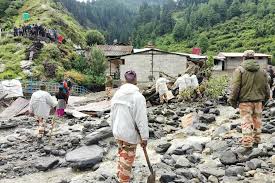
Uttarakhand’s Dharali Suffers Deadly Cloudburst as Climate Change, Urbanization Collide
A sudden cloudburst triggered a flash flood and mudslide that decimated the Himalayan town of Dharali in Uttarakhand, leaving at least four people dead and around 100 missing, in what is being called one of the worst natural disasters to hit the region in recent years.
A monstrous wave of mud, rocks, and debris swept down a narrow mountain gorge, flattening homes, submerging entire buildings, and sending terrified residents running for their lives. Videos captured by onlookers and news agencies show multi-storey buildings being swallowed by a torrent of freezing brown sludge — a nightmarish visual that has shaken the nation.
What Happened: The Cloudburst That Triggered Chaos
21cm of Rain in Hours — A Meteorological Flashpoint
According to the India Meteorological Department, the region experienced an “extremely heavy rainfall event” — recording over 21 centimeters (8 inches) of rain in just a few hours. Officials say this intense rainfall was the result of a cloudburst, a sudden downpour over a concentrated area, known to trigger floods and landslides in mountainous terrain.
This surge of water and debris ripped through Dharali, a town known for its picturesque views and thriving tourism economy.
“This is a serious situation,” said Sanjay Seth, Minister of State for Defence. “We have received information about four confirmed deaths and about 100 people are missing. We pray for their safety.”
Ground Zero: Buildings Buried, Lives Uprooted
Eyewitnesses Recall the Horror
Residents say they heard a “thunderous roar” before the mudslide struck, giving them only seconds to flee. Some were caught mid-evacuation, while others vanished as buildings collapsed around them.
“The mud was 50 feet deep in some areas,” said State Disaster Response Force (SDRF) Commander Arpan Yaduvanshi, describing how entire structures were submerged.
Images released by the Indian Army show a post-disaster landscape that looks like a warzone — rooftops barely visible above sludge, power lines down, and roads replaced by rivers of mud.
Rescue on a War Footing
Indian Army Deploys 150 Troops as Time Runs Out
With the disaster zone rendered almost inaccessible, India’s Army has stepped in with 150 troops already on the ground. According to Army spokesperson Suneel Bartwal, 20 survivors have been rescued so far.
“Search and rescue efforts are ongoing, with all available resources being deployed to locate and evacuate any remaining stranded persons,” Bartwal said.
Rescue teams are using drones, dogs, and heavy machinery to dig through the thick sludge — racing against time, weather, and the risk of more landslides.
Political and Public Reactions
Leaders Pledge Support, Climate Activists Demand Accountability
Prime Minister Narendra Modi expressed his condolences, assuring the public that “no stone is being left unturned” in providing aid.
Uttarakhand Chief Minister Pushkar Singh Dhami called the event “extremely sad and distressing”, noting that rescue efforts are being carried out “on a war footing.”
But beyond the immediate tragedy, the event has reignited long-standing debates around climate resilience and reckless development.
The Climate Crisis: A Deadly New Normal?
Experts Warn of More Frequent & Intense Disasters
Flash floods and landslides are not new to the Indian Himalayan region, especially during the monsoon season from June to September, but experts say climate change is making them more deadly and frequent.
According to the UN’s World Meteorological Organization, events like this are a “distress signal” of an increasingly unstable global water cycle. Rainfall is becoming more erratic, sudden, and intense, particularly in vulnerable high-altitude regions like Uttarakhand.
“This tragedy is a deadly cocktail,” said Harjeet Singh, a climate activist from Satat Sampada Climate Foundation.
“Global warming is super-charging our monsoons with extreme rain, while on the ground, our own policies — cutting hills, unsustainable construction, and choking rivers — are destroying natural defenses.”
Urbanization vs. Ecology
Experts Slam “Reckless Development” in Eco-Sensitive Zones
Uttarakhand, often referred to as the “Dev Bhoomi” (Land of the Gods), has seen a surge in infrastructure development, much of it unscientific and unsustainable, experts argue.
From road-widening projects to unchecked tourism construction, fragile hills are being destabilized. “We are building in the path of nature,” Singh added. “And nature is pushing back harder every time.”
Environmentalists have long called for stricter building regulations, reforestation, and better drainage systems. But little has changed, and every monsoon brings more tragedy.
What’s Next: Immediate Priorities & Long-Term Lessons
Search, Rescue, and Rebuild — But Will We Learn?
For now, the focus remains on rescuing the missing, recovering the dead, and stabilizing the region to prevent further disaster. Relief camps are being set up for displaced families. Roads and bridges are being cleared and rebuilt.
However, unless systemic changes are implemented, such catastrophes will not remain isolated events — they will become seasonal certainties.
As the mud settles in Dharali, the question facing India is not only how to rebuild, but how to prevent the next disaster.
A Tragedy that Could Become Routine
The flash flood in Uttarakhand is a harrowing reminder that the climate emergency is no longer a distant future — it is a present danger. While nature played its part, policy failure, poor planning, and ecological disregard magnified the devastation.
Unless this moment leads to tangible, science-backed action, future headlines may read the same — only with different town names and higher body counts.

More Stories
From Mushrooms to Murder Plots: The Chilling Case of Erin Patterson
Trump Tipped for Nobel Peace Prize After Cambodia Credits Him With Ending Deadly Border Clash With Thailand
Hezbollah Explodes in Rage as Lebanon Moves to Disarm Militias—Israel Keeps Bombing, US Pulls Strings