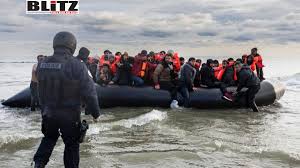
From Policy to Action in the Channel
The UK government has welcomed a new hardline approach by French police to physically disable small boats used by people smugglers, as the number of illegal Channel crossings surges to a new high.
Transport Secretary Heidi Alexander confirmed that Britain supports the “difficult but necessary” new tactics being deployed on the French coast—including using knives to puncture inflatable vessels before they can depart.
The move comes just days before French President Emmanuel Macron is due to arrive in London for a state visit that is expected to produce a joint declaration on border enforcement and asylum cooperation.
French Police Slash Boats: A Visual Shift in Policy
In footage released last week, French officers were filmed slashing a black zodiac boat near Boulogne—marking the clearest visual evidence yet of Paris taking direct action to prevent departures rather than merely patrolling beaches.
Alexander, speaking on Times Radio, acknowledged the footage was “not pleasant” but justified:
“We saw French authorities using new tactics to stop the boats in shallow waters. That’s action we are supporting.”
The UK has long pushed for proactive interdiction on French soil, and this shift appears to reflect growing bilateral alignment on the need to disrupt smuggling operations before migrants reach the open sea.
Illegal Crossings Surge: A Political Timebomb
Prime Minister Keir Starmer is facing mounting political pressure after over 20,000 migrants crossed the Channel in the first six months of 2025—a staggering 48% increase compared to the same period in 2024.
While the UK has spent hundreds of millions of pounds funding French patrols and surveillance since 2020, critics have questioned the return on investment.
When asked whether this cross-Channel spending was “value for money,” Alexander responded:
“We will always spend our money in the public interest, in the national interest.”
A New Era of Cooperation: Macron’s State Visit
President Macron arrives in London today for a two-day state visit, which includes:
-
A formal Anglo-French summit
-
A joint press briefing with Prime Minister Starmer
-
An address to the UK Parliament
Sources close to the talks suggest France is ready to formally authorise police intervention up to 300 metres offshore—an expansion of operational reach into shallow coastal waters that had previously been off-limits due to international maritime law.
This would require careful legal navigation of the UN Convention on the Law of the Sea, which bars interventions in open waters unless for rescue or humanitarian purposes.
If successful, the move would represent the most substantial shift in Channel enforcement protocols in over a decade.
“One In, One Out” Deal: Still on the Table?
There is still uncertainty surrounding a proposed “one in, one out” asylum agreement, in which the UK would commit to resettling a migrant from France for every one returned across the Channel.
While politically controversial, such a framework is seen by some as the only way to break the smuggling business model without breaching international asylum protections.
Alexander declined to speculate on the deal:
“I’m not going to speculate on the coverage of this possibility … but we’re working very closely with the French authorities.”
Analysts believe that political optics on both sides of the Channel will determine how far leaders are willing to go with reciprocal commitments.
CEO Brief: Why This Matters to Business and Policy Leaders
1. Security and Stability
The rising numbers of unregulated crossings are creating strain on border infrastructure, law enforcement, and social services in the UK and EU.
2. Bilateral Relations
Improved Anglo-French cooperation may spill over into trade, defense, and digital regulation, especially post-Brexit.
3. Global Perception
The UK’s and France’s coordinated tactics are being watched closely by other migrant transit countries, including Greece and Italy.
4. Legal Precedent
Expanding coastal intervention zones could inspire similar reinterpretations of maritime enforcement boundaries elsewhere in Europe.
For business leaders, particularly in logistics, security, and infrastructure sectors, border predictability and policy consistency are key to minimizing downstream disruptions.
Public Opinion and Media Optics
While some human rights groups have condemned the visuals of boat-slashing as inhumane, polling shows that a majority of UK voters support tougher enforcement measures—especially when framed as preventing dangerous and exploitative journeys.
Indeed, the “broken system” narrative is gaining traction on both sides of the political aisle, reinforcing Starmer’s need to act decisively while avoiding legal or ethical overreach.
What Comes Next?
Key Watchpoints:
-
Will France commit formally to 300-metre enforcement waters?
-
Will the UK agree to any migrant resettlement quotas?
-
Will there be a follow-up summit in Calais or Dover in Q3?
-
How will smugglers adapt to new coastal disruptions?
If this week’s summit succeeds, it could redefine European border enforcement for the next decade—and significantly shape public trust in the UK’s immigration system.
Summary of Developments
| Event | French police slashing smugglers’ boats near Boulogne |
|---|---|
| UK Position | Fully supportive of new French tactics |
| Macron’s State Visit | Ongoing, includes Anglo-French summit in London |
| Illegal Crossings (2025 YTD) | 20,000+ (up 48% YoY) |
| Possible Agreement | “One in, one out” migrant deal (not confirmed) |
| Expanded Police Powers | Up to 300m from French shore under discussion |
A Tactical Shift or Symbolic Gesture?
While the slashing of boats marks a dramatic new visual symbol of enforcement, only time will tell if these measures truly deter smugglers or simply push them into more dangerous or hidden tactics.
What is clear: The UK and France are aligning more closely on enforcement than ever before. Whether that translates into fewer crossings or just louder headlines, this week’s summit will be pivotal.

More Stories
From Mushrooms to Murder Plots: The Chilling Case of Erin Patterson
Trump Tipped for Nobel Peace Prize After Cambodia Credits Him With Ending Deadly Border Clash With Thailand
Hezbollah Explodes in Rage as Lebanon Moves to Disarm Militias—Israel Keeps Bombing, US Pulls Strings