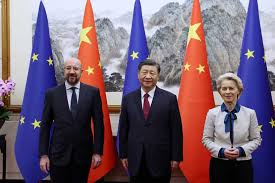
Beijing Pushes Back on Brussels Ahead of Pivotal Talks Over Trade Imbalances, Rare Earths, and Market Access
As tensions rise ahead of a crucial EU-China summit, Beijing has delivered a sharply worded rebuke to Brussels, urging the European Union to “rebalance its mentality” instead of focusing solely on economic ties. The comments come just one day after European Commission President Ursula von der Leyen called for a “rebalancing” of trade relations, accusing China of unfair practices and maintaining the largest trade surplus “in the history of mankind.”
Beijing to Brussels: It’s Not the Trade, It’s Your Thinking
During a press briefing on Wednesday, Chinese Foreign Ministry spokeswoman Mao Ning fired back at the EU’s increasingly tough stance on China, particularly on trade and market access.
“It is hoped that the European side realises that what needs to be rebalanced right now is Europe’s mentality, not China-EU economic and trade relations,” Mao said.
This rhetorical escalation sets the tone for what’s shaping up to be a tense summit between the two economic superpowers, with von der Leyen and European Council President Antonio Costa scheduled to travel to Beijing later this month.
Europe’s Case: Massive Trade Deficit, Market Barriers, and Rare Earth Worries
Speaking to the European Parliament in Strasbourg, von der Leyen took a tough line, painting a picture of extreme imbalance in the current trade relationship.
“Beijing is running the largest trade surplus in the history of mankind,” she declared, citing a massive $357 billion trade deficit between the EU and China in 2024.
Von der Leyen accused Beijing of creating an uneven playing field—limiting European access to Chinese markets, erecting barriers to investment, and imposing export controls on critical materials like rare earths.
The EU’s objective in the upcoming summit is twofold:
-
Ease export restrictions on rare earth elements crucial for clean tech, defense, and electronics.
-
Secure broader market access for European businesses operating in China.
In addition, the Commission has floated the idea of developing alternative supply chains, potentially reducing reliance on Chinese imports of strategic resources.
China’s Rebuttal: “Objective, Rational, Pragmatic” Policy Needed
Beijing countered by warning against what it described as a “turbulent” global context, urging Brussels to focus on constructive diplomacy over confrontation.
“We hope that the European Union will truly establish a more objective and rational understanding of China,” Mao Ning said.
“And pursue a more positive and pragmatic China policy.”
The Chinese government has consistently rejected EU and U.S. criticisms of state subsidies, forced technology transfers, and market distortion tactics, arguing that Western economies are unfairly politicizing global trade.
Behind the Scenes: Rare Earths, AI Chips, and Trade Weaponization
At the heart of the friction is a growing geopolitical and economic rivalry over rare earths, semiconductors, and emerging technologies. With global supply chains still under stress post-pandemic and in the wake of U.S.-China tech decoupling, Europe finds itself caught between aligning with Washington’s more hawkish stance—or attempting its own brand of “de-risking” without completely severing ties with Beijing.
Beijing’s export controls on gallium and germanium—critical for semiconductor manufacturing—have rattled both Brussels and private sector players across Europe. Meanwhile, European firms continue to complain of non-reciprocal barriers inside China, especially in sectors like:
-
Renewable energy
-
Automotive manufacturing
-
Pharmaceuticals
-
High-tech components
What This Means for European CEOs and Global Investors
This public war of words signals rising uncertainty for EU-based manufacturers, importers, and investors reliant on Chinese trade flows. The stakes are high:
-
Auto and EV sectors could face retaliatory tariffs or licensing hurdles if the EU tightens its import investigations.
-
Clean tech and battery producers risk being cut off from key rare earth inputs.
-
Pharmaceutical and biotech industries may face increased scrutiny or restricted approvals in China.
At the same time, China is working to retain global investment, even as domestic growth shows signs of slowing and confidence in its regulatory environment remains fragile.
Outlook: Diplomatic Showdown or Strategic Reset?
The upcoming summit will serve as a litmus test for whether the EU and China can recalibrate their economic engagement or if they are headed for a long-term, rules-based economic decoupling.
Both sides have incentives to maintain a functional relationship:
-
China is still Europe’s largest trading partner.
-
The EU remains a critical market for Chinese EVs, electronics, and solar equipment.
-
Neither side can afford full-scale isolation amid a fragile global economy.
But unless genuine policy concessions are made on both sides, the friction may harden into a new phase of strategic economic rivalry—with global markets and supply chains caught in the crossfire.
Trade Rhetoric Heats Up Ahead of Crucial EU-China Summit
As the EU prepares to press China on market fairness and critical resource access, Beijing is making it clear: change your perception, not just your policies. With both sides digging in, CEOs and investors across Europe and Asia should brace for greater regulatory volatility and supply chain recalibration in the months ahead.

More Stories
From Mushrooms to Murder Plots: The Chilling Case of Erin Patterson
Trump Tipped for Nobel Peace Prize After Cambodia Credits Him With Ending Deadly Border Clash With Thailand
Hezbollah Explodes in Rage as Lebanon Moves to Disarm Militias—Israel Keeps Bombing, US Pulls Strings