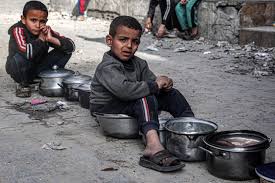
Desperate Crowds Clash Over Airdropped Food as International Pressure Mounts
The Gaza Strip is spiraling deeper into a humanitarian nightmare. Food scarcity, malnutrition, and hunger-related deaths are rising sharply, igniting chaos at aid drop zones and driving international condemnation.
In a dramatic attempt to avert full-scale famine, Jordanian and Emirati aircraft dropped 25 tonnes of food into the region on Sunday. Israel also announced a limited “tactical pause” in military operations to facilitate humanitarian aid — but the efforts are falling painfully short, according to UN officials and humanitarian groups.
Alarming Statistics: Children Dying of Hunger
WHO: 63 Hunger Deaths in July Alone, Including 24 Children Under Five
The World Health Organisation (WHO) has raised a red flag, reporting that 74 people have died of malnutrition so far in 2025 — with 63 of those deaths occurring in July. Most were children under the age of five, and many were declared dead on arrival at medical facilities, already showing severe signs of wasting.
“The crisis remains entirely preventable,” said a WHO spokesperson. “Deliberate blocking and delay of large-scale food, health, and humanitarian aid has cost many lives.”
The UN World Food Programme (WFP) echoed these concerns, warning that 470,000 people in Gaza are enduring ‘famine-like’ conditions, and that one-third of the population has not eaten in days.
Tactical Pause or Tactical Optics?
Israel Responds to Global Criticism But Accusations of Blockade Persist
In response to growing international scrutiny, the Israeli military began a daily pause in operations from 10:00 AM to 8:00 PM in specific areas: Al-Mawasi (south), Deir el-Balah (central), and Gaza City (north). Prime Minister Benjamin Netanyahu, however, shifted blame to the UN, accusing it of spreading falsehoods about aid obstruction.
“There are secure routes for aid. There always have been. No more excuses,” Netanyahu said during a press conference at an Israeli airbase.
Despite these claims, Israel’s full blockade from March to May cut off all food, fuel, and medical supplies. And although it has since eased restrictions, major aid agencies remain sidelined, replaced by a controversial new US-backed entity — the Gaza Humanitarian Foundation (GHF).
Aid Delivery Sparks Chaos, Panic
“It Felt Like a War”: Civilians Trample Each Other for Cans of Food
At a recent Israeli food drop in Gaza City’s Tel el-Hawa district, the scene turned frenzied. Hundreds rushed to grab parachuted food amid cries of hunger and desperation.
“Hunger is merciless,” said 23-year-old Samih Humeid. “The quantities were extremely limited — not enough even for a few people. I only managed to get three cans of fava beans.”
In many cases, people risked their lives to access the aid. According to Gaza’s civil defence agency, 27 Palestinians were killed on Sunday, 12 of them near aid distribution zones. While independent verification is difficult due to media restrictions, the death toll highlights the perilous state of humanitarian access.
International Outcry Grows Louder
Germany, UN, and NGOs Demand Immediate and Sustained Humanitarian Access
Germany’s Chancellor Friedrich Merz urged Netanyahu to allow “urgently needed humanitarian aid now.” The UN Emergency Relief Coordinator Tom Fletcher said his teams are on standby to utilize Israel’s brief operational pause to deliver life-saving supplies.
Meanwhile, Oxfam’s regional policy lead Bushra Khalidi criticized the limited scope of current efforts:
“Starvation won’t be solved by a few trucks or airdrops. What’s needed is a full humanitarian response — ceasefire, open crossings, large-scale aid, and above all, political will.”
Political Controversy: Who Controls the Aid?
Humanitarian Groups Refuse to Work with US-Backed Gaza Foundation
Many international NGOs have refused to cooperate with the Gaza Humanitarian Foundation, citing concerns that it further entrenches Israel’s military strategy. Reports suggest that hundreds of civilians have been killed while attempting to reach GHF-operated distribution points.
This has led to a fragmented and dangerous aid landscape, where desperation meets distrust and insufficient resources.
Famine, War Crimes, and Legal Challenges
ICC Warrant Looms Over Netanyahu, Gallant for Starvation as a Weapon
The humanitarian crisis in Gaza has also entered the international legal arena. The International Criminal Court (ICC) in November 2024 issued arrest warrants for Netanyahu and former defence minister Yoav Gallant, citing “reasonable grounds” to suspect the use of starvation as a method of warfare — a war crime under international law. Israel denies the allegations.
Economic Collapse and Psychological Toll
Gaza’s Two Million Inhabitants Face Hunger, Trauma, and Uncertain Future
With Gaza’s economy in ruins, agriculture decimated, and imports nearly non-existent, over two million people now rely entirely on international food assistance. Aid deliveries are sporadic, dangerous, and insufficient by all metrics.
Residents like 30-year-old Suad Ishtaywi describe a life reduced to survival. Her husband returns empty-handed from food lines each day.
“All I want is to feed my children. That’s my life’s wish now,” she said.
The Path Forward: Ceasefire and Coordinated Relief
Humanitarian leaders agree on one core solution: a permanent ceasefire, unimpeded aid access, and internationally coordinated distribution.
Without that, the current aid drops — no matter how dramatic — are little more than symbolic gestures in the face of a rapidly accelerating humanitarian catastrophe.
“We’re racing against time,” said a UN official. “Without unified action, we may soon be counting the dead in thousands — not hundreds.”


More Stories
From Mushrooms to Murder Plots: The Chilling Case of Erin Patterson
Trump Tipped for Nobel Peace Prize After Cambodia Credits Him With Ending Deadly Border Clash With Thailand
Hezbollah Explodes in Rage as Lebanon Moves to Disarm Militias—Israel Keeps Bombing, US Pulls Strings